
As AI becomes a permanent part of higher education, students need clear guidance on using these tools responsibly. Academic Integrity helps learners understand ethical decision-making, plagiarism, and the appropriate use of AI in academic work.
Introduction
Artificial intelligence is rapidly changing higher education, and with it, the landscape of academic integrity.
As tools like ChatGPT become more accessible, universities are facing a growing challenge: how to prevent cheating while still embracing innovation. 90% of students report using AI tools for coursework (Freeman, 2025) and 40% admit using AI on assignments without permission (Sharma, 2025), raising concerns about fairness, learning outcomes, and the long term value of a degree.
Without a clear strategy, AI misuse can lead to inconsistent policies, faculty frustration, and reputational risk.
To stay ahead, universities must rethink academic integrity for the AI era and adopt scalable solutions that prioritize education, clarity, and prevention.
What Is Academic Integrity in the Age of AI
Academic integrity refers to honest and ethical behavior in academic work. In today’s environment, that definition must expand to include how students use artificial intelligence.
AI and academic integrity are now directly connected. While AI can support learning, it can also be misused to generate assignments, complete assessments, or bypass original thinking.
The challenge for institutions is not just stopping cheating. It is clearly defining what responsible AI use looks like.
Why AI Cheating Is a Growing Problem in Higher Education
AI has made academic misconduct easier, faster, and significantly harder to detect. With tools like ChatGPT widely available, students can now generate full essays in seconds, paraphrase existing content to avoid plagiarism detection, solve complex problems with step by step assistance, and submit work that appears original but lacks authentic effort.
At the same time, many institutions are still working to define clear and consistent policies around AI use. This lack of clarity leaves both students and faculty uncertain about what is acceptable, creating inconsistency in expectations and enforcement across campus.
As a result, questions about AI and academic integrity are becoming more common. Students and educators alike are asking whether using AI is considered cheating, how AI generated work can be detected, and what actually constitutes misconduct in this new environment.
These are no longer just student concerns. They represent a growing institutional challenge that universities must address with clear policies, education, and proactive strategies.
The Impact of AI Misuse on Universities
Failing to address AI and academic integrity can have serious consequences for universities. If employers start to question whether students truly earned their grades, the credibility of both the institution and its degrees is at risk.
Faculty are also feeling the strain. Many are expected to detect AI misuse without clear guidance or tools, which increases workload, frustration, and burnout. At the same time, accrediting bodies expect institutions to maintain strong academic standards, even as technology continues to evolve.
There are also real operational costs. Investigating cases, handling appeals, and updating policies all take time and resources. Academic integrity is no longer just a student issue—it’s a university-wide risk that requires a proactive approach.
Why Academic Integrity Education Is a Strategic Investment
Investing in academic integrity education is one of the most effective ways for universities to reduce risk and protect both students and the institution in the age of AI.
As technology continues to evolve, many academic integrity violations stem not from intentional misconduct, but from confusion about expectations. Proactive education helps eliminate that ambiguity by clearly defining responsible AI use, reinforcing institutional policies, and giving both students and faculty a shared understanding of ethical academic behavior.
The 3rd Millennium Academic Integrity Course provides a scalable way to deliver this education consistently across campus. Through engaging, research based content, the course helps students understand academic integrity, navigate gray areas around AI use, and apply ethical decision making in real situations.
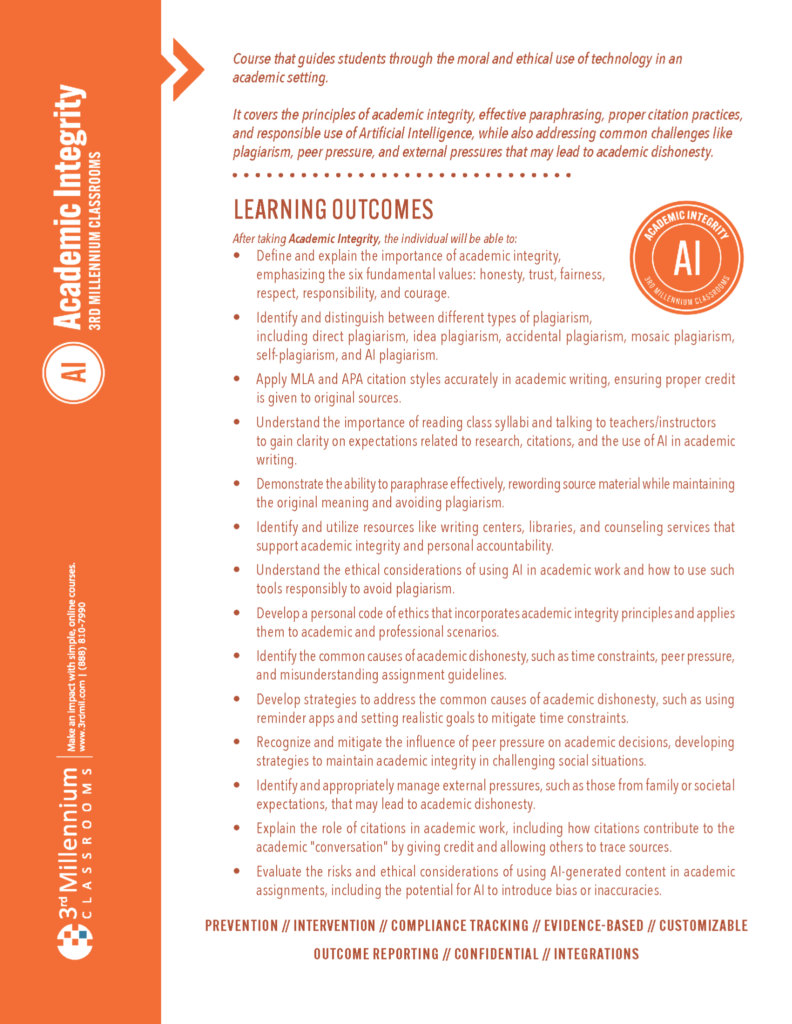
Instead of reacting to violations after the fact, institutions can adopt a prevention-first approach that directly relieves administrative strain. This course is designed to save time by reducing the need for reactive case management, ease staff capacity challenges by minimizing repeat incidents, and improve student performance through clearer expectations and early intervention. By addressing the root causes of integrity issues early, institutions can avoid the far greater operational, reputational, and academic costs of widespread misconduct.
The Growing Policy Pressure on Universities
Universities are under increasing pressure to address academic integrity in the context of AI while ensuring consistency across policies and enforcement.
As AI tools become more integrated into learning, institutions are expected to clearly define acceptable use, align expectations across departments, and maintain academic rigor. Accrediting bodies are also placing greater emphasis on transparency, integrity, and measurable learning outcomes.
This shift means institutions are no longer evaluated solely on how they respond to misconduct. They must also demonstrate that they are proactively addressing academic integrity through education, policy alignment, and campus-wide implementation.
The 3rd Millennium Academic Integrity Course supports these efforts by helping institutions standardize training and reinforce policies at scale. With consistent, trackable implementation, universities can reduce risk while ensuring students understand expectations in an AI driven academic environment.
How to Prevent Academic Integrity Violations in the AI Era
Preventing academic integrity violations requires a coordinated, campus-wide approach built on clarity, consistency, and education.
Effective institutions prioritize clear expectations by establishing policies that define acceptable AI use and ensuring those expectations are communicated across all courses. They also invest in faculty support, helping instructors adapt to AI-related challenges and design assignments that encourage authentic learning.
At the same time, fostering a culture of honesty and accountability is essential. When students understand both the expectations and the reasons behind them, they are more likely to make ethical choices.
Scalable education plays a central role in this process. The 3rd Millennium Academic Integrity Course enables institutions to deliver consistent training that reinforces expectations, reduces confusion, and empowers students to make informed decisions.
Free Resources to Support Your Academic Integrity Strategy
In addition to training, many institutions benefit from practical tools that support implementation and policy alignment.
3rd Millennium offers free downloadable academic integrity toolkits and whitepapers designed to help universities strengthen policies, align with best practices, and address AI-related challenges more effectively.

These resources can be used alongside the 3rd Millennium Academic Integrity Course to build a comprehensive, scalable approach to preventing AI-related misconduct.
A Scalable Solution for AI and Academic Integrity
To effectively address AI-related misconduct, universities need solutions that reach every student and align with institutional policies.
The 3rd Millennium Academic Integrity Course is an evidence-based program designed to help students understand expectations, take responsibility for their work, and navigate academic integrity in an AI-driven environment.
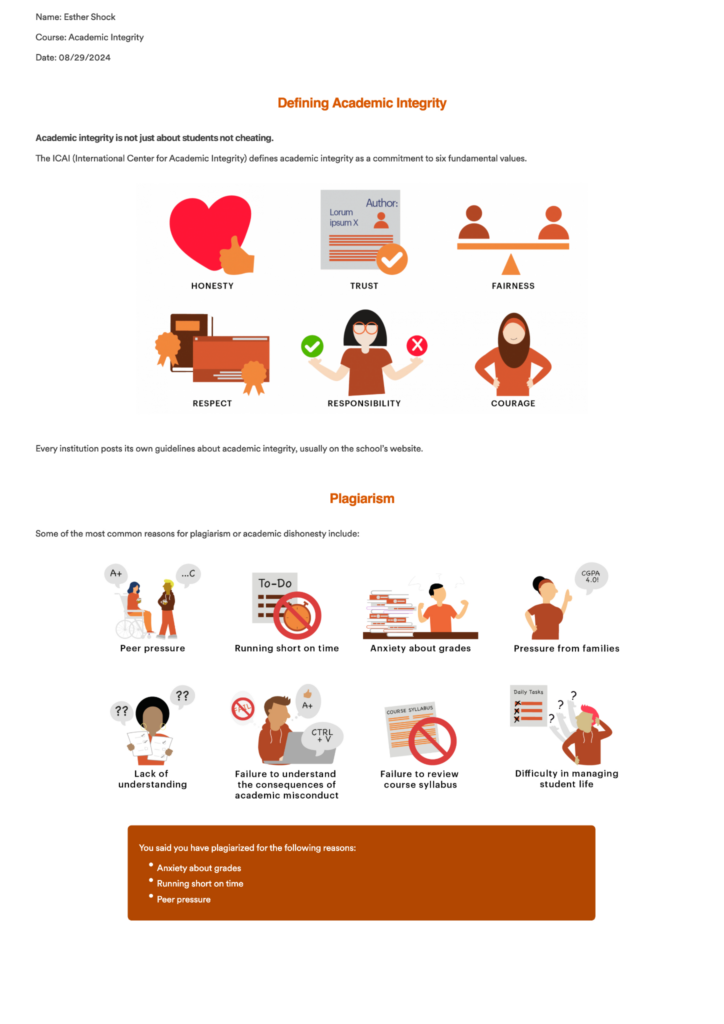
The course provides students with clear, practical guidance on academic integrity, including how AI can and cannot be used in academic work. Through real-world scenarios, students learn to recognize gray areas, avoid common mistakes, and apply ethical decision-making in realistic situations. The curriculum also addresses plagiarism, unauthorized collaboration, and AI-generated content, ensuring students understand the full scope of academic misconduct.
Designed to be interactive and engaging, the course uses videos, knowledge checks, and scenario-based learning to reinforce key concepts and improve retention.
With built-in assessments and reporting, universities can easily track completion and demonstrate compliance, while ensuring all students receive consistent, high-quality instruction.
By focusing on education rather than enforcement alone, institutions can reduce violations, create consistency across campus, and build a culture of integrity that supports long term student success.
Best Practices for Academic Integrity in Higher Education
Universities that successfully manage academic integrity in the age of AI take a proactive and consistent approach.
This includes implementing institution-wide policies that address AI use, providing mandatory training for students, and ensuring faculty have the resources needed to adapt their teaching and assessment strategies. Clear and consistent communication of expectations is essential, as is the thoughtful use of technology without over reliance on detection tools.
Most importantly, successful institutions focus on fostering a culture that values honesty, accountability, and learning over shortcuts.
By combining clear policies, effective education, and institutional alignment, universities can stay ahead of evolving challenges while maintaining strong academic standards.
Frequently Asked Questions About AI and Academic Integrity
Is Using AI Considered Cheating in College?
It depends on institutional and course policies. Using AI without permission or in ways that replace original work is often considered academic misconduct.
How Can Universities Prevent AI Cheating?
Universities can reduce AI cheating by using The 3rd Millennium Academic Integrity Course to provide clear student training on academic integrity and responsible AI use.
What is Academic Integrity in Higher Education?
Academic integrity is the commitment to honesty, fairness, and responsibility in academic work.
Why is Academic Integrity Important?
It protects the value of degrees, ensures fairness for students, and maintains institutional credibility.
AI is transforming higher education, but it does not have to undermine academic integrity.
Conclusion
With clear policies, consistent expectations, and scalable training, universities can prevent AI cheating, protect their reputation, and support meaningful learning.
The institutions that succeed will be those that take a proactive approach.
The 3rd Millennium Academic Integrity Course helps universities lead the way by equipping students with the knowledge and skills they need to navigate academic integrity in an AI-driven world.
Learn how 3rd Millennium can help your institution prevent AI cheating and strengthen academic integrity today.
References:
*40% of students: Sharma, S. (2025, September 4). 40% of American students use AI on assignments without permission: What’s really happening in US classrooms. The Times of India. https://timesofindia.indiatimes.com/education/news/40-of-american-students-use-ai-on-assignments-without-permission-whats-really-happening-in-us-classrooms/articleshow/123701891.cms
*90% of students: Freeman, J. (2025, February 26). Student generative AI survey 2025. HEPI. https://www.hepi.ac.uk/reports/student-generative-ai-survey-2025/?utm_source=chatgpt.com